We read the whole chart.Then we print it.
Your real chart — or both of yours, scored against each other — calculated to the arcminute. Not a template with your name dropped in.
Three Portraits
Each one a full natal chart wheel and a written reading, on a single piece of wall art. Pick one to see exactly what it is.
Your whole chart, read as one portrait.
We take the exact sky at the moment you were born and turn it into a reading you can hang on a wall. Your Sun, Moon, and Rising across the top, then seven sections — your core self, your emotional world, your heart, your will, your gifts, your lessons, and the face you show the world.
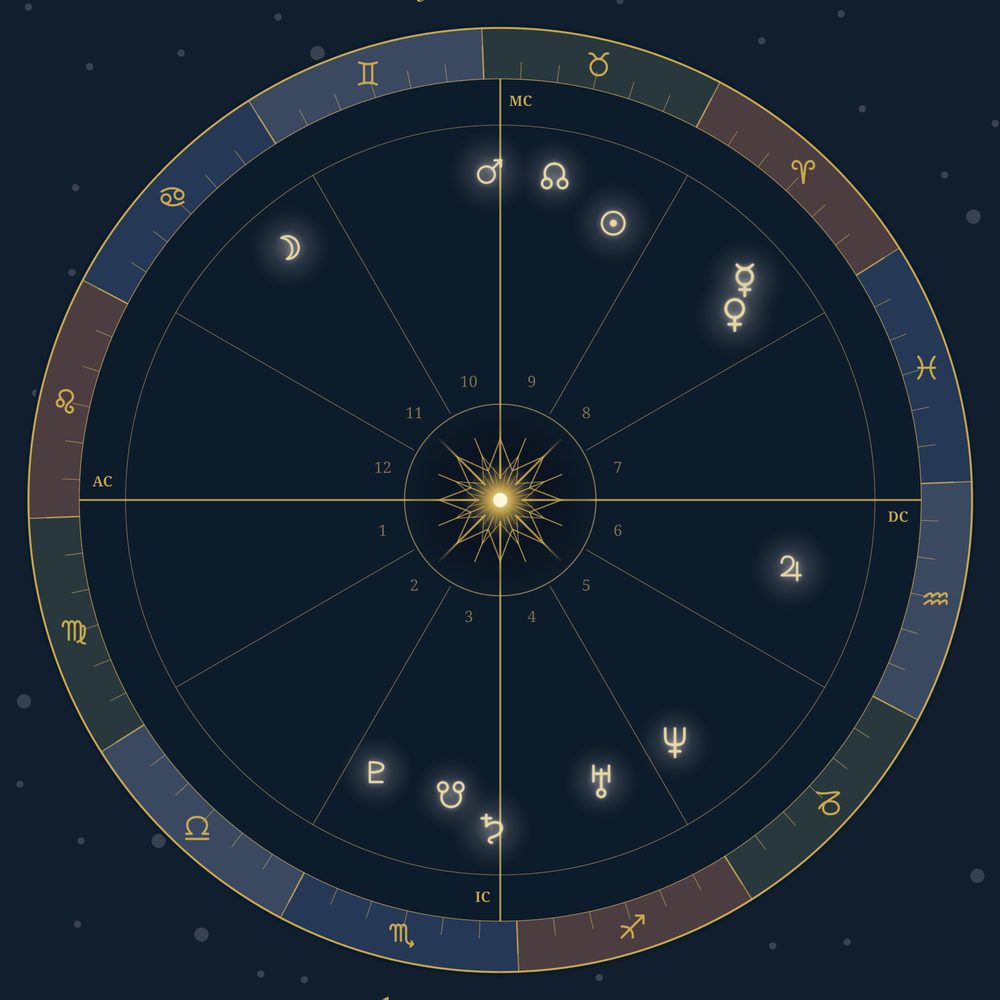
Your natal wheel is printed beside it with every planet's exact degree, drawn from a professional ephemeris. Every symbol on the wheel marks where that planet actually was.
Know your birth time? Include it. It adds your Rising sign, your houses, and your Midheaven, and it fixes the Moon exactly — the one placement that can otherwise land in the wrong sign. It's usually on your birth certificate.
Don't know it? Order anyway. The Rising sign, houses, and Midheaven are left off the portrait entirely — we won't guess a time, because a guessed one gives a guessed Rising with about a 1-in-12 chance of being right. Your reading is built from your Sun and planets instead.
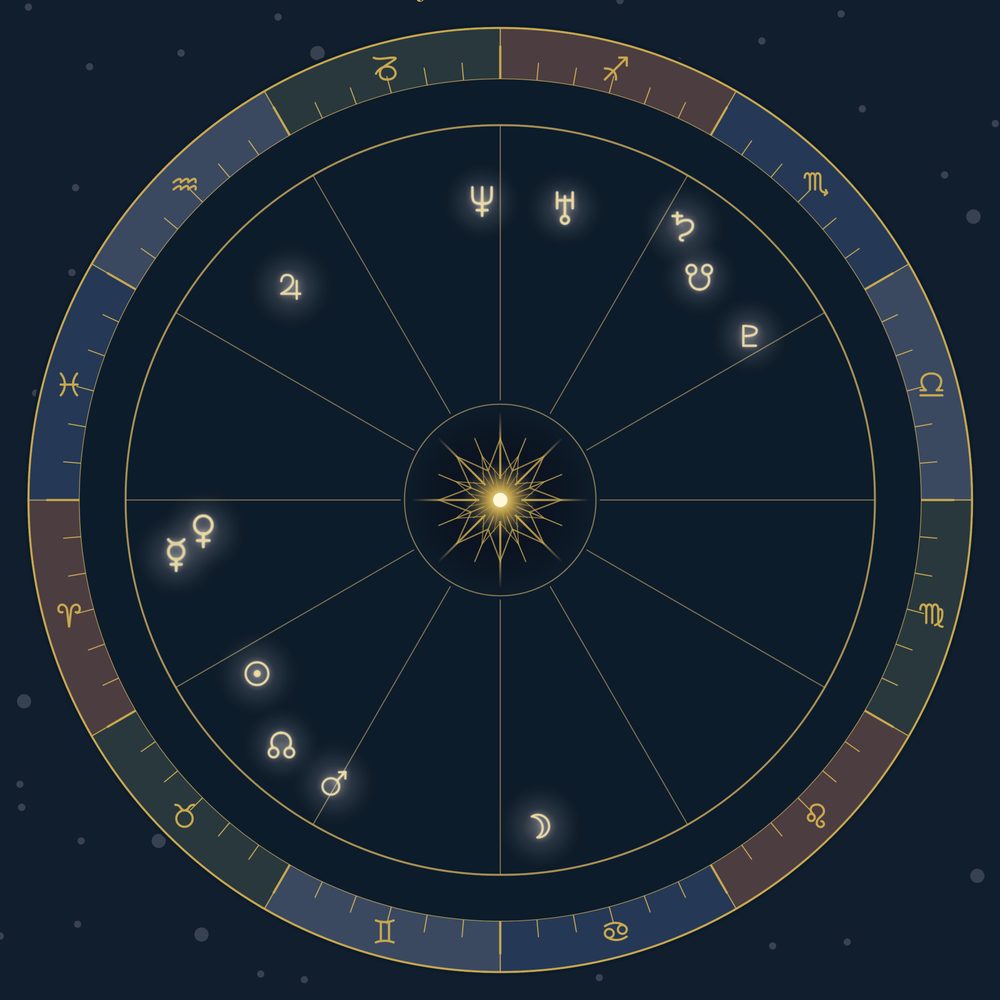
The Moon is the one exception. It still appears on your wheel, placed from noon on your birth date — a reference point, not a guess at your time. The Moon moves far enough in a day to cross into the next sign, so if yours lands near an edge, the portrait says so.
Everything the Individual is, signed by you.
It reads like a letter that happens to be a star chart. Mother to daughter, daughter to mother, one friend to another.
Everything in the Individual portrait, written for someone you love and signed by you — your name in the opening line and again at the end, so it's clear from the first sentence who this came from and why.
All you need is their birth date and place, and the name you want on it — Mom, Dad, Aunt Shirley, or your own. Whatever they actually call you is what gets printed.
Know their birth time? Include it. It adds their Rising sign, their houses, and their Midheaven, and it fixes the Moon exactly — the one placement that can otherwise land in the wrong sign. It's usually on their birth certificate.
Don't know it? Leave it blank and order anyway. You won't have to ask them a strange question and spoil the surprise. The Rising sign, houses, and Midheaven are left off the portrait entirely — we won't guess a time, because a guessed one gives a guessed Rising with about a 1-in-12 chance of being right. Their reading is built from their Sun and planets instead.
The Moon is the one exception. It still appears on their wheel, placed from noon on their birth date — a reference point, not a guess at their time. The Moon moves far enough in a day to cross into the next sign, so if theirs lands near an edge, the portrait says so.
What the aspects say about the two of you.
Both charts, side by side, scored against each other on real aspect math — six planets in your chart measured against eight points in theirs, then the same in reverse, each aspect weighted by how exact it is. Six categories: Sun, Moon, Venus, Mercury, Mars, and Jupiter.
Your scores aren't raw numbers. They're ranked against a reference distribution of simulated couples in your exact situation, so a 90 means roughly one couple in ten scores higher than you on that axis.
Which means it can come back low. Some couples land in the top band, some don't. We don't have a version of this that flatters everyone, and we're not going to build one.
Birth times: get them if you can, but don't let a missing one stop you. Five of the six categories barely depend on a birth time — the Sun, Mercury, Venus, Mars, and Jupiter each move no more than a degree or two across an entire day, which is small against the 10° orb the scoring uses. Those five are as solid without a birth time as with one.
The Moon is the exception, and we don't fudge it. The Moon covers between 11.8° and 15.4° in a day, so without a birth time its true position can sit as much as 7.69° from where a noon reference puts it. Comparing two Moons when one of them might be nearly 8° out would invent aspects that aren't there. So if either birth time is missing, the Moon is taken out: off that person's wheel, off the planet table, and the Moon score is left blank rather than filled with a number we can't stand behind. The remaining five categories are re-weighted to carry the whole result.
You aren't penalized for it either way. Your scores are ranked against couples in the same situation you're in — both times known, one known, or neither — so you're never measured against couples who gave us more than you could. Across thousands of test couples, the same pair scores within about a point of where they'd have landed with both times known. It does change the shape of the reading rather than the fairness of it: with the Moon out, the other five carry the weight, so an individual result can move either direction. Whoever's time is missing simply has no Rising sign, houses, or Midheaven on their side of the portrait.
If you don't like something you see, that's information too.
What arrives
One piece of wall art. The full chart wheel, and the whole reading, printed together.
seven written sections.
How It Works
Simple for you. Not simple underneath.
Choose your portrait
Individual, gift, or couples — then pick your size and whether you want digital, printed, or framed.
Enter the birth details
Date and place. Add the birth time if you know it — it's worth looking up. If you don't, we build the reading around what's certain.
We calculate
Every planet's position comes from a professional ephemeris, and the reading is written against your actual chart.
It arrives
Digital in minutes, anywhere we sell. Prints arrive in 5–8 business days and framed in 6–12, shipped free within the United States.
Your birth details are never sold
We use your name, date, time, and place of birth to calculate your chart and write your reading. That is the only thing they are used for. Producing your portrait means sharing them with the services that run the chart calculation, look up your birth city, and draft the reading text — each one is named by name in our Privacy Policy. They are never sold and never used for marketing. Your birth details are not kept in any database, and the files generated for your portrait are removed within seven days. You can ask us to delete your details once your order is complete.
Before you buy this one.
We score your compatibility with real aspect math, and then we show you what it found. Not what you were hoping for.
This is how we do it. Six planets in your chart — Sun, Moon, Mercury, Venus, Mars and Jupiter — are measured against eight points in theirs: those same six, plus Saturn and the Ascendant. Then the whole thing again in the other direction. Conjunctions, sextiles, squares, trines, oppositions, each weighted by how exact it is — a trine 2° from exact is worth double one that's 8° off. Not a little more. Double. That produces six category scores, one per planet.
This is why the score means something. Your raw numbers never reach the portrait. They're ranked against a reference distribution of simulated couples in your exact situation — both birth times known, one known, or neither — so a 90 means roughly one couple in ten scores higher than you on that axis. It isn't a formula that happened to land on 90. And because the six scores are calculated separately, they disagree with each other: a couple can score 90 on Mercury and 12 on Moon. That's what a real reading looks like.
And this is what it is. Because the scoring is real, it can come back low. Some couples land in the top band. Some don't. We don't have a version of this that flatters everyone, and we're not going to build one — a score that always says "strong connection" is worth nothing to anybody.
You aren't buying a result we picked. You're buying the result of the calculation.
The portrait itself never prints a number. That's deliberate — a number hanging in a frame stops being a conversation and becomes a verdict. If you want the figures, there's a $10 Score Report you can add at checkout: every score written out, with a few paragraphs on each explaining what it means for your two charts specifically. It arrives by email as soon as your chart is calculated.
- A couple can score 90 on Mercury and 12 on Moon. The six categories are calculated independently, so they disagree with each other. There is no single compatibility number being smoothed into a verdict.
- Six categories, real aspects. Conjunction, sextile, square, trine, and opposition across both charts, 10° orb, each graded by how exact it is. Five categories when a birth time is missing — the Moon is left out rather than estimated.
- Percentile-mapped, not raw. Each category is ranked against a reference distribution of simulated couples for your exact configuration, so the number describes where you sit among couples rather than what a formula produced.
- The full range actually gets used. The scoring was tested against thousands of couples to confirm that all four outcome bands fire in practice. They land at roughly 5% / 33% / 38% / 24% — not just the comfortable middle.
- Leaving out a birth time doesn't tilt the scoring for or against you. Each configuration — both times known, one known, neither — is ranked against its own reference set, so you're compared with couples in the same situation rather than measured against couples who had more information. It does change what gets scored: without a birth time the Moon is left out and the remaining five carry the weight. Across thousands of test couples that lands within about a point of where the same pair scored with both times known — but for more than a quarter of couples it moves by ten points or more, in either direction.
- We never guess a birth time. There was an option to assume noon. We removed it. A guessed noon produces a guessed Rising sign with about a 1-in-12 chance of being the right one, and we won't print a guess as a fact. Without a birth time, the Rising sign, houses, and Midheaven are left off the portrait entirely and the reading is built from the Sun and planets.
- When the Moon is uncertain, the portrait says so. The Moon travels between 11.8° and 15.4° in a day, so a chart with no birth time can place it as much as 7.69° from where it actually was. That's enough that about 11% of no-time charts would show a different Moon sign if the true time were known — and every one of those portraits says so, on the portrait itself.
- The positions are independently verifiable. Planetary positions come from a professional ephemeris; the Ascendant and Midheaven are calculated from your birth time and place. We re-derive whole charts against Swiss Ephemeris as a check — most recently twelve values per chart, across two charts, with zero discrepancies. You can verify the planetary positions yourself in professional astrology software.
- Want the numbers themselves? The portrait shows a tier and a phrase for each category and never a figure. The $10 Couples Score Report is the other half — the Alignment Score, every category score, and the Attraction Score that appears nowhere else, each with a few paragraphs on what that number means for your two charts, named sign by sign. It's a checkbox on the order form just under the birth details, and it arrives as its own email as soon as your chart is calculated, whichever format you ordered.
Formats & Delivery
Choose the presentation that fits the wall.
Available in 24×18 and 32×24.
Digital download
High-resolution file in both sizes, ready to print yourself.
Delivered to your email within minutes.
Available within the United States. Where we sell
Fine art print
Archival matte paper, unframed. All prints ship rolled — for a flat, ready-to-hang piece, choose framed.
Delivered in 5–8 business days.
Ships free within the United States. Shipping details
Fine art framed
Pearl paper in a black wood frame, ready to hang the moment it arrives.
Delivered in 6–12 business days.
Ships free within the United States. Shipping details
Questions
The things people ask before they order.
Where do you ship?
Within the United States, and only there for the moment. Fine art prints and framed pieces ship free anywhere in the US, and digital downloads are delivered by email, usually within minutes.
That is narrower than it was a week ago, and we narrowed it on purpose. We had been selling digital portraits into a handful of other countries, chosen because a digital sale in each one created no tax registration obligation at the volume we do. That reasoning was sound as far as it went — and it only went half way. Selling to someone in another country can also carry obligations about how their personal information is handled, and we had not reviewed those properly. So we stopped rather than carry on and hope. We do intend to sell worldwide, and we are working through what each country actually requires before we open it.
This is about where you are, not where the chart is. We calculate portraits for births anywhere on earth. The person on the portrait can have been born absolutely anywhere — a grandmother born in Frankfurt and living in Ohio is no trouble at all. Only the billing address on your payment method decides whether we are able to sell to you. Full shipping and delivery details.
Is this Western astrology?
Yes. Every portrait is calculated in the Western tropical system — the same one almost everyone in the U.S. and Europe means when they say "I'm a Leo." It measures the sky against the seasons, so the zodiac begins at the spring equinox rather than against the constellations as they sit today. That is the difference between Western and Vedic (Sidereal) astrology, and it is why the signs on your portrait match the ones you already know.
Nothing comes from a template. Your planets are calculated from your date, your place, and — when you have it — your time of birth, down to the arcminute.
What information do I need to order?
A birth date and a birth place — city and state, or city and country, is enough. Birth time is optional but worth looking up; it's usually on the birth certificate. For the couples portrait, the same for both people. For a gift, add the name you want printed as the sender — Mom, Dad, Aunt Shirley, or your own.
What does each planet mean on an Individual or Gift portrait?
Your portrait has a written section for each one, and the heading on the portrait tells you what it covers:
- Sun — The Core Self. Who you are underneath the habits.
- Moon — The Emotional World. How you feel things and what settles you.
- Venus — The Heart. How you love and what you find beautiful.
- Mars — The Will. Your drive, your temper, how you go after things.
- Jupiter — The Gifts. Where things come easily and where you grow.
- Saturn — The Lessons. What you've had to work at, and what it taught you.
- Rising — The Face You Show the World. How you come across before people know you.
The Rising section only appears if we have your birth time — it's the one part of the portrait that can't be worked out without it.
You'll also see the North Node and South Node on your chart wheel and in the chart details. They don't get their own written section, but they're worth knowing: the North Node is where you're headed — the direction you grow in, the thing that feels like a stretch. The South Node is what you already know how to do — the familiar ground you fall back on when you're tired. They always sit exactly opposite each other, which is the point: you move toward one by letting go of the other.
What does the red R next to a planet mean?
It marks a planet that was retrograde when you were born. From where we stand on Earth, a planet sometimes appears to slow, stop, and travel backwards against the stars for a few weeks or months. Nothing actually reverses — it's a trick of perspective as our orbit passes theirs, the same way a slower car seems to slide backwards when you overtake it.
Astrologically it's read as that planet working inward rather than outward — the same nature, turned reflective. It's a common thing to have; most charts carry two or three. We print it in red so you can find it at a glance. The Sun and Moon never go retrograde. Every other body on your chart can.
Why isn't it on the Couples portrait? Because every row there is a comparison — your Sun measured against theirs, your Venus against theirs. Retrograde status belongs to one chart on its own. It doesn't change how two charts meet, and nothing in the compatibility scoring uses it. The same is true of the North and South Nodes. So the couples planet table shows exactly what gets scored and nothing that doesn't, while the Individual and Gift portraits — where the whole point is a description of one person — show both.
What do the six categories mean on a Couples portrait?
Different planets from the solo portrait, because compatibility asks different questions. Each category compares one of your placements against the same one in your partner's chart:
- Sun — whether your life directions point the same way
- Moon — how your emotional worlds meet
- Venus — romantic chemistry
- Mercury — how you communicate
- Mars — physical drive and energy
- Jupiter — whether you grow in the same direction
Saturn appears on the solo portrait but not here, and Mercury appears here but not there. A couples portrait is asking how two people meet, not who each of them is on their own.
The North and South Nodes and the retrograde markers are left off the couples planet table for the same reason — they describe one chart on its own, and nothing in the scoring compares them. Both appear on the Individual and Gift portraits, where the whole point is a description of one person.
What's actually written on a Couples portrait?
Five written sections across the bottom, and the score in each category sets the tone of the paragraph that goes with it. A high Venus score and a low one produce genuinely different writing, not the same paragraph with a different adjective. That's why the scoring matters even though the numbers themselves are small on the page.
With both birth times known, the five sections are:
- Their Suns — one sign meets the other
- Their Moons — the emotional truth
- Their Love & Mind — Venus and Mercury share this one: desire and expression
- Their Drives — Mars: passion and momentum
- What They Build — Jupiter: the long game
Why do Venus and Mercury share a section? Because the layout has five, and with both birth times known there are six things to say. Venus and Mercury are the natural pair — how you love and how you talk to each other — so they get one section with a sentence each.
If either birth time is missing, the Moon comes out of the scoring, which leaves five categories for five sections. So Venus and Mercury separate and each takes a section of its own: Their Love — Desire & Connection and Their Communication — Mind & Expression.
That's why two Couples portraits can look different side by side. Neither one got less — five full sections either way, the same size, nothing padded and nothing blank.
What if I don't know my exact birth time?
Order anyway. Without a birth time the Rising sign, houses, and Midheaven are left off the portrait entirely, and the reading is built from your Sun and planets instead. Everything else on the portrait is unaffected.
If you don't guess my birth time, why is there a Moon on my chart?
Fair question. Without a birth time the Moon is placed from noon on your birth date. Noon is a reference point, not a guess at your time — it is used for the Moon and nothing else, which is why the Rising sign, houses, and Midheaven are simply absent rather than estimated. The Moon is the only body that moves far enough in one day to change sign — it travels about half a sign between one noon and the next. So if yours lands near the edge of a sign, your real birth time could put it in the next one over. When that's possible, we print a line on the portrait telling you so, before you hang it on the wall.
Why keep it at all? Because it's right about nine times out of ten, and the Moon is too important to leave off — it's your emotional world, and one of the three placements most people actually know about themselves. Dropping it to avoid being wrong one time in ten would have cost the other nine a section of their reading.
Then why not use noon for the rest of the chart too?
Because the rest of the chart depends on the time far more than the Moon does. A guessed noon produces a guessed Rising sign with about a 1-in-12 chance of being the right one, and the houses and Midheaven move with it. The Moon at noon is right most of the time and we flag it when it isn't; a Rising sign at noon is wrong eleven times in twelve and there is no way to flag which. We had that option once and removed it.
How accurate are the charts?
Planetary positions come from a professional ephemeris. The Ascendant and Midheaven are calculated from your birth time and place. We re-derive whole charts against Swiss Ephemeris as a check — most recently twelve values per chart, across two charts, with zero discrepancies. You can verify the planetary positions yourself in professional astrology software.
Will the couples score tell me something I don't want to hear?
It might. The scoring is real, so it can come back low, and the six categories disagree with each other by design. We'd rather tell you that here than have you find out after it's framed.
Do we both need our birth times for the couples portrait?
No. Five of the six categories come from planets that move no more than about a degree in a day, which is nothing against a 10° orb — they're unaffected. Only the Moon moves far enough to matter, and rather than estimate it we take it out: its score is left blank and the other five are re-weighted. Your result is ranked against couples in the same situation as you, so a missing time can't quietly raise or lower it. Get the times if you can — one or both missing is still a portrait worth buying.
Why do you keep the Moon on a solo portrait but drop it from a couples one?
Because they're being asked to do different jobs. On a solo portrait the Moon is a description of you, and a noon Moon is in the right sign about nine times out of ten — worth keeping, with a note on the few that could move. In a couples portrait the Moon isn't a description, it's an input to a number: your Moon measured against theirs. An 8° error there doesn't make the reading slightly less certain, it manufactures aspects that never existed and prints them as a score. A placement we can caveat is worth keeping. A score we can't is not.
Is the couples portrait only for romantic partners?
Yes — as it's written today. Venus is scored as romance and prints phrases like Natural Romantic Chemistry; Mars is scored as physical drive and prints Strong Physical Drive. Those two labels only make sense between partners. The underlying math would happily run on any two birth charts, but the words printed on the portrait assume a couple, so we don't recommend it for a parent and child, two friends, or business partners. If that's what you're after, two Individual portraits side by side is the better buy.
Which one makes the best gift?
All three of them. Don't let the name mislead you — the one called Gift isn't the only giftable one. It's the Individual portrait with your name written into it, so it reads as a message from you rather than a product they were sent: mother to daughter, aunt to niece, one friend to another. That's what you're adding, not the giftability.
An Individual portrait is a fine gift exactly as it is, if you'd rather the whole thing be about them and not about you.
A Couples portrait makes a genuinely good anniversary or engagement present — or a wedding gift, if you're brave. The scoring is real, and it can come back low. Most couples enjoy that it isn't flattery. Know your audience.
What do you do with my birth information?
We use it to calculate your chart and write your reading. That's the whole of it — we don't sell it, and we don't use it to market anything to you. Producing your portrait does mean sharing your details with the services that run the chart calculation, look up your birth city, and draft the reading text; each one is named in our Privacy Policy. Your birth details are not kept in any database, and the files generated for your portrait are removed within seven days. Your order itself stays in our store records, the same as any other order you'd place anywhere.
Is it scientific?
The astronomy is. Every planetary position on your portrait is a real, checkable calculation of where that body actually was. What astrology reads into those positions is a tradition of interpretation, not a science, and we don't pretend otherwise.
How do I hang the framed portrait so it's straight?
There are two sawtooth hangers on the back rather than a single wire, which is what keeps a wide frame from ever going crooked — but it does mean two nails that have to be level with each other. There's a trick that makes that foolproof, and the whole job takes about five minutes.
What you need: a strip of painter's tape, a pencil, a tape measure, a level, and a hammer. The hanging hardware comes in the box.
- 1. Tape the back — lay the portrait face down on something soft and run one strip of painter's tape straight across the back, over both sawtooth hangers.
- 2. Mark the notches — pencil a dot on the tape at the centre notch of each hanger. Those two dots are where your nails go.
- 3. Measure the drop — measure from the top edge of the frame down to the notch. It's usually a quarter to a half inch. Write it down.
- 4. Mark the wall — decide where the top of the frame should sit and make a light pencil mark. Measure down from it by the drop you just noted and make a second mark. That lower one is your nail height.
- 5. Move the tape to the wall — peel the strip off the back, line it up on that lower mark, hold the level against it, and press it down when it reads true.
- 6. Nail through the dots — a nail at each pencil dot, left about an eighth of an inch proud so the hanger has something to grip.
- 7. Peel and hang — take the tape off the wall and drop both notches onto the nails.
The tape carries the exact spacing from the back of your frame to the wall, so there's no measuring between the two nails and nothing to get wrong.
Why two hangers instead of a wire? A wire is easier to get on the wall and worse to live with. Two fixed points hold a wide frame in one plane: it can't tilt when a door slams, the weight is split across two anchors instead of loading one spot in the drywall, and the bottom corners sit flat instead of bowing away from it. A little more care going up, and then it stays exactly where you put it.
Who makes these
Celestial Kin Threads is a father and a daughter. We built all of it ourselves — the chart engine, the writing, the layout, this page you're reading.

That's most of the explanation for why the portraits are the way they are. When it's two of you and nobody else, there's no department to hide a shortcut behind. You end up checking your own math against a professional ephemeris, twelve values at a time, because you'd rather be right than fast — and because your name is on it.
We use AI to help write the readings, working from your chart and nothing else — there's no stock paragraph for Venus in Libra sitting ready to have a name stamped on it. The positions and the scores underneath aren't generated. They're calculated.
If something's wrong with your portrait, the person who reads that email is the person who built the thing.
Calculated, not guessed.
A complete reading of your real chart — measured to the arcminute, printed to hang on a wall.
Choose your portrait